|
|
|
|||
|
Contact: Mail |
|
|||
|
The Prototype Märklin-H0-Knowledge Layout-Building Modelstock |
|
|||
|
Special Knowledge
about Tracks What
do the tracks in the Märklin H0 system look like? |
|
|||
|
state: 20.02.2026 17:35 |
|
|||
|
The Märklin system differs
from NEARLY ALL other brands: The Märklin tracks have a
„central conductor"! These are the knobs in the
middle between the rails. The specialist speaks of „stud contacts",
German “Punktkontakte”, abbreviation “Puko”. Very old tracks had a
continuous central rail as a central conductor. A few newer products, even
after 1957, such as the turntable, were only available with a continuous
central conductor. |
|
|||
|
There were also competing
products with center conductors from Trix and others. The compatibility has
not been investigated. This symmetrical
construction enables absolutely revealing track figures. The traction current
comes from the middle, is picked up by the currant collector shoe in the
middle under the traction vehicle and diverted to the rails via the wheels. |
|
|
||
|
Topics
on this page: Which track sections
are/were there? The
two CURRENT H0 track systems from Märklin: |
|
|||
|
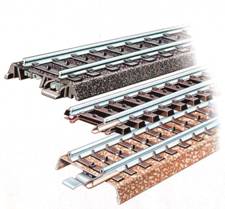
1st: The C-Track (above
in the first picture) with a rather prototypical ballast bed made of plastic.
Numbers 24xxx five digits. |
|
|
||
|
Attention: There are tracks from Trix that
look similar, without a center conductor, and from Märklin for the
battery-powered models “my world” with plastic rails;
both are unsuitable for our purposes! The tracks in „start up” packaging are fully
compatible. Attention: The C Track is the further development of the „Track 2000”, which was developed for the „ALPHA” program in
1988 and can be recognized by the copper-colored contacts. Numbers 20xx four
digits. The incline of the ballast bed is different and lugs on the C track
prevent it from being plugged together directly with the ALPHA track. Attention: In the first years of production up to 2000,
Märklin had problems with the plasticizer in the plastic, which made the
tracks brittle. The newer, better ones have „ASA" and the year of
production injected as a mark at the bottom. As of 2004 supposedly harmless. |
|
|||
|
2nd: The K-track (in
the middle in the first picture) without ballast bed with sleepers made of plastic,
in which the current-carrying conductor tracks are embedded on the underside. |
|
|
||
|
The K-Track is also
available as a flexible track for freely configurable arches. Attention: The K-tracks were made with hollow profile rails up to
1980, numbers 21xx four-digit, later with full profile rails, numbers 22xx
four-digit. The old H0 track systems: |
|
|||
|
3rd: The M-Track (below
in the first picture) has not been manufactured since 2000, but is still
popular with many people. This track is the cheapest to get, of course in
second hand shops. There was a whole range of variants that are all
compatible with one another, including the ones mentioned above with the
continuous center conductor. A newer version was also sold under the „Primex"
brand, inexpensive selection of track pieces in simplified, rather gray
colors, packaged in blister packs and sold in supermarkets and harware stores
without any advice. The aim was to spark interest in Märklin model railways. |
|
|
||
|
There were many
different colors for the M tracks. Number ranges 36xx, 51xx and 52xx
four-digit, 36xx also with letters for differentiation. See “M-tracks since 1935 – an
uncomplete overview”. Before the
introduction of stud contacts, the center conductor was designed as a
continuous third rail. These tracks are all conpatible. However, when
transitioning from the stud contacts to a continuous center conductor rail,
it is necessary to check that the sliders on the vehicles do not get caught
at the transition. If necessary, the end of the center conductor rail must be
bent dorn slightly. Attention: Between 1953 and 1957, Märklin produced the
"Modellgleis", a luxury version of the M-track. The „Modellgleis“ system is
described in the article „Märklin Modellgleise - a
closer look at these exotics”. The track sections of the M track system with a
continuous central conductor and point contacts as well as the
"Modellgleise" are compatible with each other. There are only
restrictions on the “Modellgleise”. Compatibility
of the systems with each other You can
combine C-, K- and M-tracks, with M-tracks also Alpha-tracks, using
transition tracks that Märklin offers / offered. These transition tracks are
only straight and 180mm long, which limits their applicability. transition track K – C : since
1999 no 24922 transition track M – C : since
1999 no 24951 transition track M – K : since
1969 no 2191, since 1981 no 2291 transition track M – Alpha : since
1988 no 2091 The possibility of
retrofitting a track from other manufacturers with a central conductor should
not go unmentioned. However, this is more for specialists ... For a very detailed description of the Märklin
tracks (german) see: Märklin-h0-Forum.de, Faq und Tipps und Tricks, rund ums Gleis, die
Märklin-h0-Gleissysteme Which
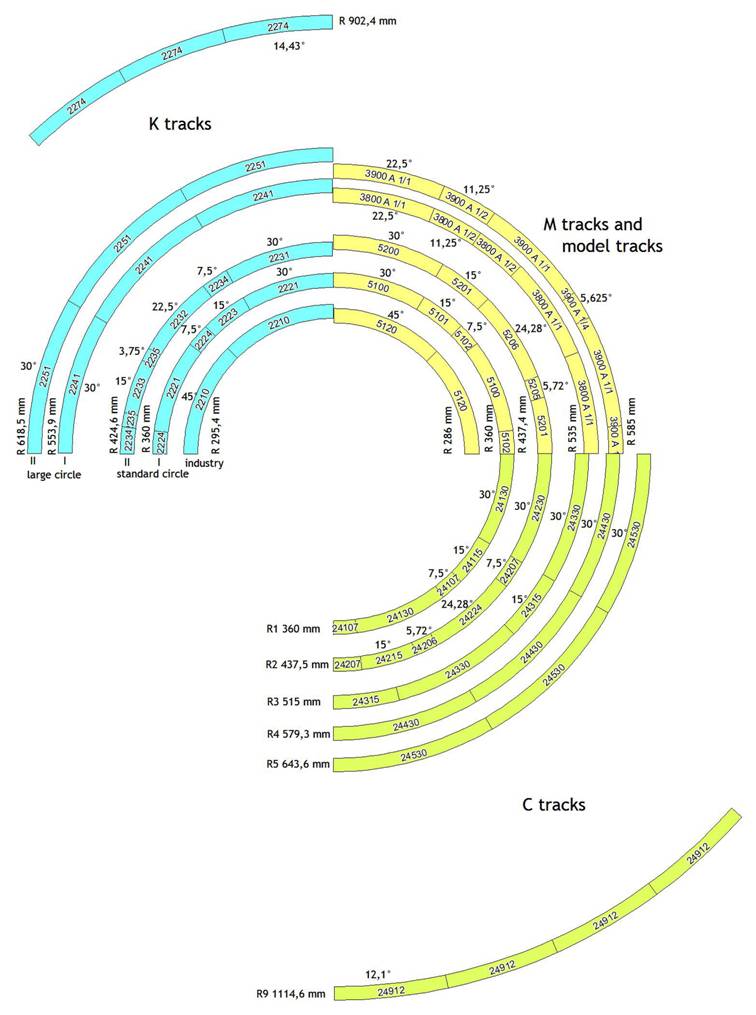
track sections are/were there? The
three Märklin track types in H0 gauge have only slight similarities in the
radii of the curves and the lengths of the straight lines. This makes
transferring a track plan from one system to another problematic. Comparison of the radii: |
|
|||
|
|
||||
|
Only radius 1 / normal
circle I is the same for all three systems. Radius 2 is the same for
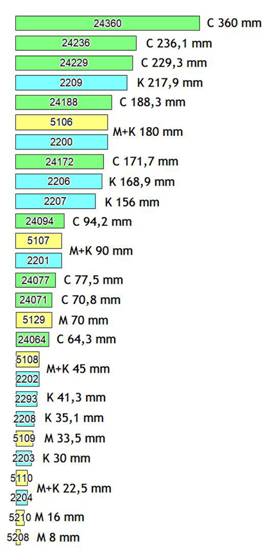
M- and C-track. Comparison of the straight
lines:
Only M- and K-track have
the same lengths. In order to assemble other
lengths from the standard track pieces, I offer tables in the subject area of
Layout
planning and construction, planing and construction aids. There are special versions
of some track pieces with functions; see "H0
Tracks with function". The feeder tracks are
shown on the page "How
does the electricity get into the Märklin H0 track?” Turnouts, double slip
turnouts and turntables are described in separate pages.
The track distances resulting from the application are then also shown there. |
|
|||
|
The Prototype Märklin-H0-Knowledge Layout-Building Modelstock |
|
|||